

Hydraulic Modelling Built
for Water & Wastewater
Treatment Works
Model treatment works hydraulics on a visual canvas, run steady-state simulations, and review water levels, headlosses, and energy grade lines in one connected workspace.
- Visual system canvas plus review-ready outputs
- Steady-state water levels and energy grade lines
- Built for treatment works, not generic network software
See the Workflow
Model, simulate, and review in one connected workspace
HydroBlocs brings the hydraulic canvas, the steady-state solver, and the review view together so teams can move from concept to technical challenge without having to rebuild the same logic in separate tools.
- 01
Build the hydraulic system visually
Assemble channels, pipes, pumps, weirs, valves, and process units on a single canvas for a treatment works.
- 02
Run a steady-state solve
Calculate water levels, flow splits, velocities, headlosses, and control points without jumping between disconnected spreadsheets.
- 03
Review the result with confidence
Inspect hydraulic profiles, identify governing controls, and clearly explain design intent to reviewers or clients.
Outputs that engineers can review immediately
- Water surface profile
- Energy grade line
- Headloss checkpoints
- Flow distribution
- Control structure visibility
- Review-ready long section
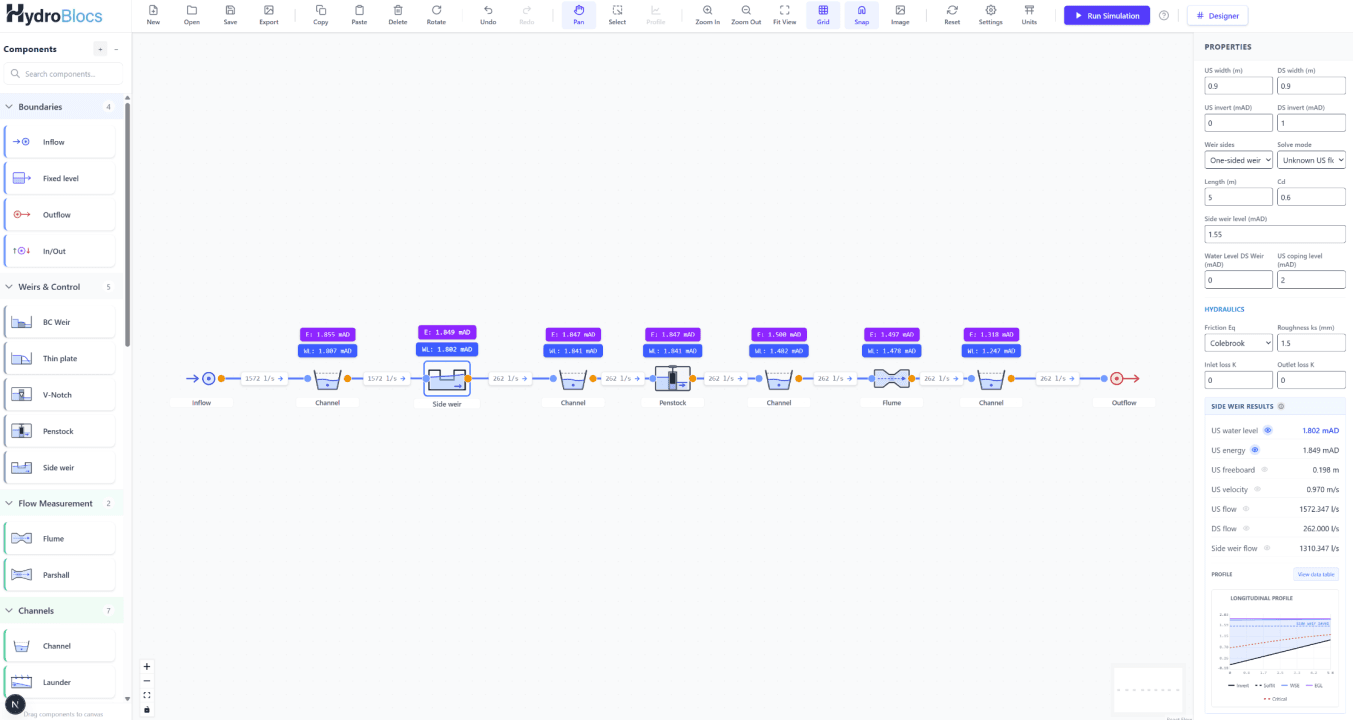
Hydraulic modelling canvas
Connected process units, control structures, and result values on one visual treatment works canvas.
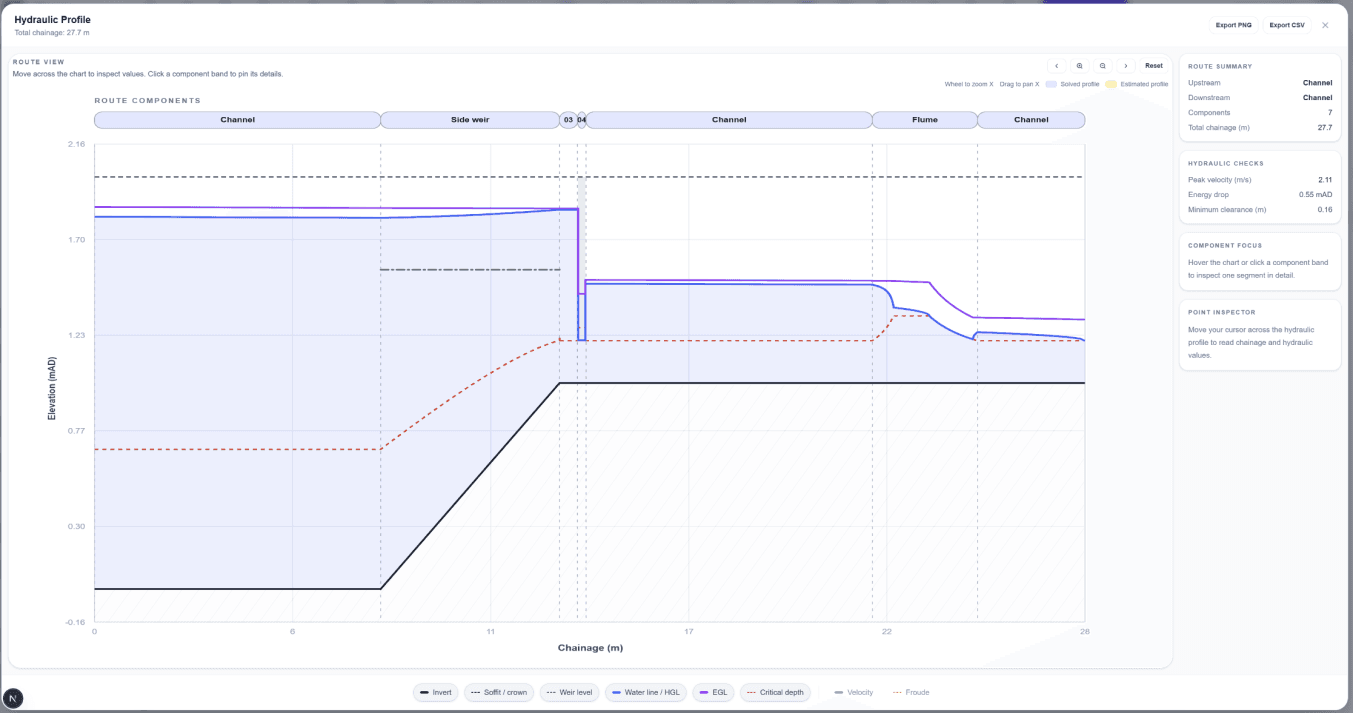
Hydraulic profile visualisation
Water surface profile, energy grade line, hydraulic controls, and structure levels across the system.
Why HydroBlocs
Beyond the Spreadsheet
Hydraulic design for water and wastewater treatment works is still often delivered through fragmented spreadsheets, manual long-sections, and disconnected calculations.
That approach can be slow to build, difficult to review, and hard to standardise across teams. Option testing becomes cumbersome, and confidence in designs can suffer when they need to be checked, explained, or challenged.
HydroBlocs provides a connected, visual hydraulic modelling environment built specifically for water and wastewater treatment works. Engineers assemble hydraulic systems graphically, connecting channels, pipes, pumps, weirs, valves, and process units, and run steady-state simulations that instantly compute water levels, flow distribution, velocities, headlosses, and energy grade lines.
What used to take days of spreadsheet work can now be modelled in minutes, giving engineering teams a quicker, clearer way to test options, understand controls, and communicate design intent.
Built for teams who deliver:
- Inlet works and storm separation design
- Treatment process hydraulic design
- Pumping stations and rising main analysis
- Option appraisal and hydraulic optioneering
- QA and technical review of hydraulic designs
Built for Treatment Works
Designed specifically for plant and process hydraulics rather than large sewer network modelling. Every feature reflects real treatment works design workflows.
Faster Engineering Iteration
Reduces reliance on manual spreadsheet iteration. Test hydraulic options in minutes, not hours, giving engineering teams more time for judgment and less for mechanics.
Easier to Review and Explain
Visual models and interactive hydraulic profiles make designs more transparent for internal review, technical challenge, and client communication.
Grounded in Engineering Practice
Commercial software checks, hand calculations, site data, and more than 15 years of real design experience underpin every aspect of the platform.
Platform Capabilities
What HydroBlocs Delivers
A complete set of tools designed specifically for the hydraulics of water and wastewater treatment plants, not adapted from generic network modelling software.
Visual Modelling Canvas
Build complete treatment works systems graphically. Connect channels, pipes, pumps, weirs, valves, and process units on an interactive canvas to assemble a full hydraulic system.
Instant Hydraulic Simulation
Run steady-state simulations across the full system with one click. Instantly compute water levels, flow distribution, velocities, headlosses, and energy grade lines.
Interactive Hydraulic Profiles
View interactive long-sections showing water surface profiles, energy grade lines, hydraulic controls, and structure levels. Inspect any point on the system in detail.
Standards-Based Calculations
Built-in equations and checks for thin-plate weirs, broad-crested weirs, V-notch weirs, flumes, and other standard hydraulic structures, grounded in established engineering practice.
Pumping & Rising Main Analysis
Assess pumped systems and rising mains with features designed for real treatment works applications. Includes pump curve analysis and pressure main hydraulics.
Web-Based Platform
Runs in any modern browser with no installation, license servers, or software management required. Access it from the office, on-site, or anywhere in between.
FAQ
Common questions from design teams evaluating HydroBlocs
If you want to discuss a specific workflow or project type, the best route is still a guided demo grounded in a real engineering context.
Request a Guided DemoWho is HydroBlocs built for?+
HydroBlocs is built for engineers and consultancies working on the hydraulics of water and wastewater treatment works, especially where design teams need a clearer workflow than spreadsheet-led modelling alone can provide.
Is HydroBlocs intended for sewer networks or treatment works?+
The product is aimed at treatment works and plant/process hydraulics rather than large-scale sewer network modelling. The workflow is focused on levels, controls, structures, and review clarity within treatment systems.
What type of analysis does HydroBlocs support?+
The current focus is on steady-state hydraulic modelling and review, including water levels, headlosses, energy grade lines, flow distribution, and hydraulic profile inspection.
Can HydroBlocs help with both design review and design development?+
Yes. A core aim of the product is to make hydraulic logic easier to challenge, explain, and review, not just easier to calculate.
How do we evaluate whether HydroBlocs is a good fit?+
The best route is a guided demo grounded in a real workflow or project type. HydroBlocs is currently offering short, practical conversations and 20-minute demos to help teams judge fit without any commitment beyond that discussion.
What is the early adopter or design partner opportunity?+
HydroBlocs is engaging with a small number of consultancies as early adopters or design partners. The idea is to shape the final product around practical workflow needs, provide priority access before general release, and explore whether there is a sensible fit.
Pilot programme open.
Built with engineering teams.
HydroBlocs is in active product development, with the core modelling workflow already established and being refined against real treatment works use cases.
We are working with a small number of consultancies as early adopters and design partners to sharpen the workflow, reporting, and QA features that matter most in practice.
- Live demo tailored to your hydraulic workflow
- Direct feedback on the roadmap and QA features
- Priority access before wider release
- Preferential terms as a founding partner
On the roadmap
- Scenario management for comparing design options side by side
- Structured QA workflows to support internal review
- Automated hydraulic design report generation
- Expanded component libraries and advanced modelling capability
Built by engineers, for engineers
HydroBlocs was developed by a Chartered Engineer with more than 15 years of experience designing treatment works hydraulics in the UK water sector.
The platform was shaped by real project work, extensive use of commercial hydraulic software, and the recurring challenges of spreadsheet-based workflows.
HydroBlocs aims to bring structure, transparency, and engineering clarity to the hydraulic design of treatment works.